Arrow right
i14y E2E Energy Efficiency Testing Framework: Testing VNF power consumption

i14y E2E Energy Efficiency Testing Framework

Testing VNF power consumption

Moving towards a unified i14y E2E Energy Efficiency Testing Framework, Rimedo Labs, in collaboration with i14y Lab, have tested the contribution of multiple Virtual Network Functions (VNFs) to the power consumption, showing how the potential energy consumed by running xApps, rApps, and RIC platforms can be measured and validated.

i14y E2E Energy Efficiency Testing Framework

One of the expected benefits of Open RAN and the use of RIC is increased energy efficiency. But promises are just that unless you can validate the anticipated effect through reliable testing. Towards this end, we have successfully continued our collaboration with Rimedo Labs on this subject, aiming to provide testing solutions that are valuable for the entire industry, furthering the Open RAN ecosystem, and enabling innovation in RAN.


The tests were conducted in the i14y Lab, using Redfish and Kepler for measuring the power consumption of our DELL R750 server hosting the Rimedo Labs and Cell On/Off Switching (COOS) rApp, along with O1-termination-related VNFs (also provided by Rimedo Labs), operating under a RAN emulated by Keysight RICTest, including the O-RAN-compliant O1 interface, and used to interact with tens of cells and hundreds of UEs. 
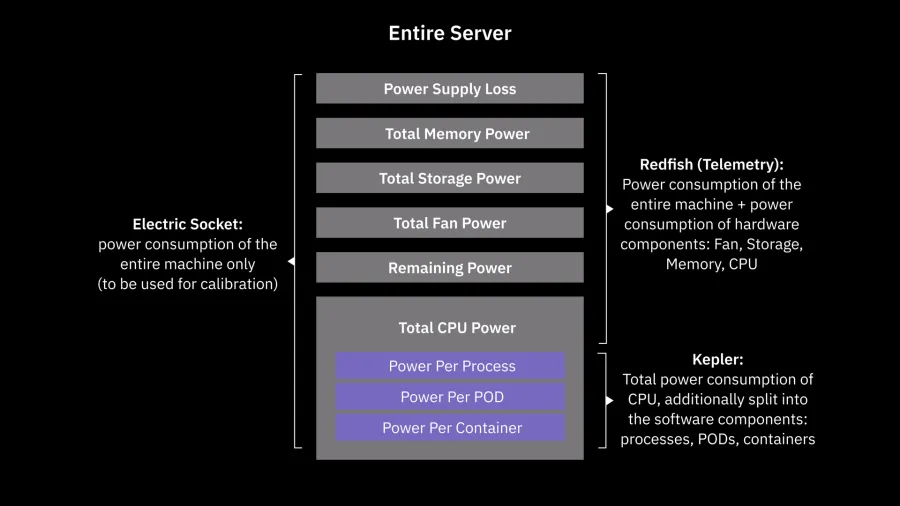
In the context of VNFs, the E2E Energy Efficiency Testing Framework proposed in the white paper, identifies key measurement points for assessing the power consumption of the virtualized setup:


  • Electric socket: measuring power consumption of the entire machine, mainly for calibration purposes.
  • Redfish Telemetry: measuring the power consumption of the entire machine, but also enabling differentiation into its hardware components, like memory, storage, fan, CPU, and power supply loss.
  • Kepler: measuring the total CPU power consumption as well as providing insights into the individual power consumption per process, per POD, or per container. 


Papers on the subject of measuring energy effieciency

Energy efficiency (EE) is one of the key challenges for contemporary and future mobile networks, including within the Open Radio Access Network (O-RAN) architecture. However, there is a significant gap in common procedures for comparing the EE of both hardware (HW) and software (SW) solutions offered by various vendors. Usually, EE improvements of both SW and HW solutions are demonstrated in specific scenarios defined by individual vendors, avoiding comparisons and benchmarking under various network conditions.


The whitepaper “i14y Energy Efficiency Testing Framework,“ published in 2025, advocates for a unified and complete end-to-end (E2E) energy testing framework, which can be used as a benchmarking environment for EE testing of O-RAN applications and networks.


The paper “A Unified E2E Energy Efficiency Testing Framework for Open RAN,” to be published later this year in the IEEE Communications Standards Magazine, details the need for unified end-to-end (E2E) EE testing for O-RAN. It analyzes the existing standards to identify missing parts and proposes a novel O-RAN E2E EE testing framework based on that. The paper is authored by Marcin Hoffmann (Rimedo Labs and Poznan University of Technology, Poland), Marcin Dryjański (Rimedo Labs), Adrian Kliks (Rimedo Labs and Poznan University of Technology, Poland), Andreas Gladisch (i14y Lab, Germany), Ajesh Pulyaar Keerthi (i14y Lab, Germany), Mohammadreza Razmi (i14y Lab, Germany), and Heiko Lehmann (T-Labs, Germany).